About the Interviewee
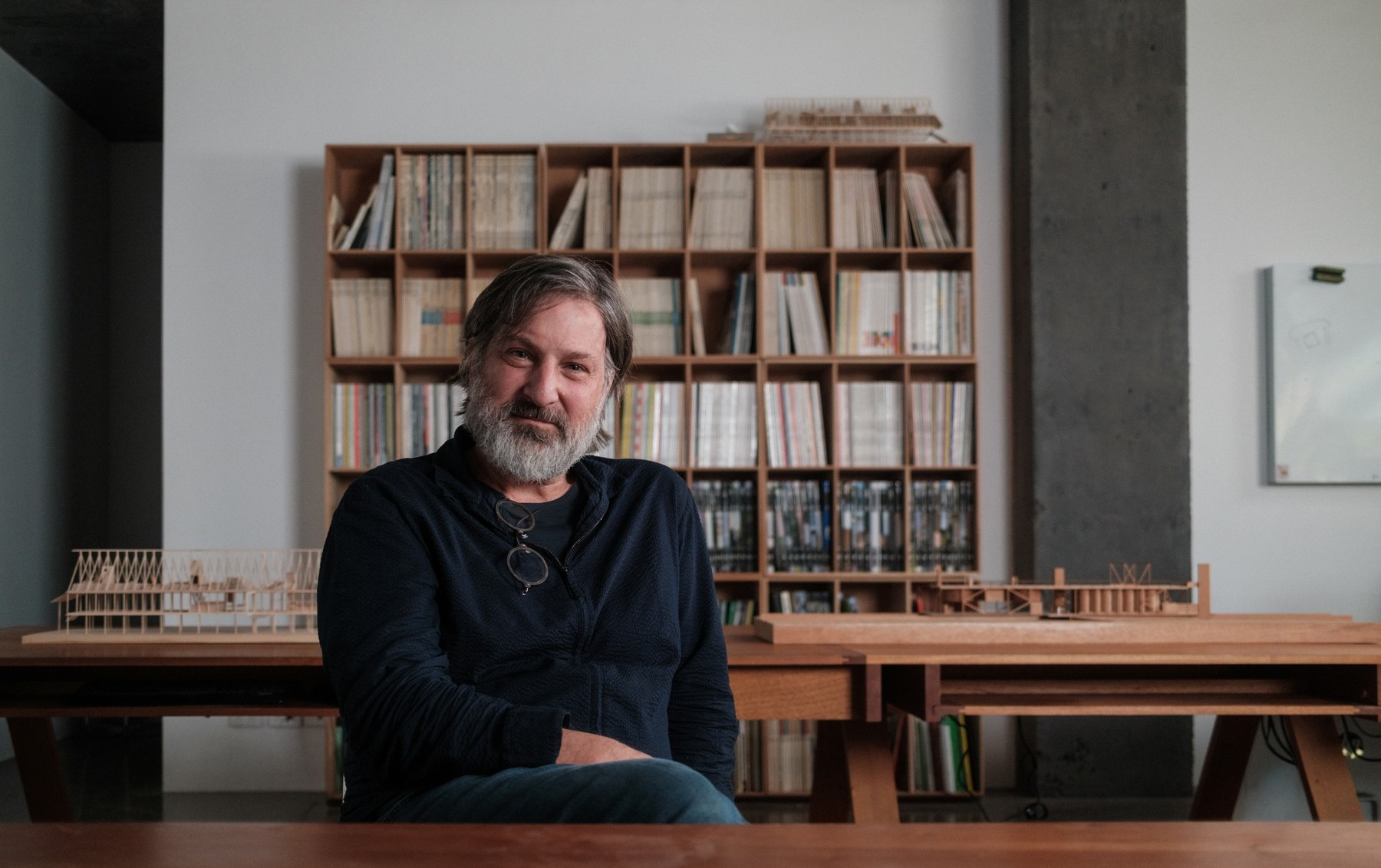
Zhen Qi is an interior designer and spatial renewal researcher whose work focuses on the transformation of existing buildings, material reuse and adaptable spatial design. His practice emphasises on-site investigation, retaining existing components and local collaboration, seeking a new balance between spatial quality, resource efficiency and long-term use.
Introduction
Must the timber flooring of an old office be removed during renovation? Does a scratched piece of stone lose its value? As interior design becomes increasingly dependent on standardised products and rapid cycles of renewal, are we also creating spaces with ever shorter lives?
Interior designer Zhen Qi believes that design should not always begin with a blank sheet of paper. The materials already present in a building, the traces of use and the existing spatial order are not problems waiting to be erased. They are points of entry for understanding a place.
In his practice, the designer’s first task is not to select new products, but to recognise the resources already there: what can be retained, what can be recombined and which traces can become part of the spatial narrative. For him, interior design is not only about shaping a visual language. It is about making responsible judgements between materials, time, users and future change.
How do you usually begin an interior design project?
I do not immediately start drawing plans, nor do I begin by searching for stylistic references. When I enter a space, I first observe what it already has.
I look at the direction of natural light, how people habitually move through the space and why particular traces have formed on walls and floors. I also try to understand where the existing materials came from, how they were installed and what condition they are in. Many design clues are already present; they simply have not been looked at carefully enough.
We once renovated an office that had been in use for more than twenty years. The most obvious problem was the ageing floor, which the client initially wanted to remove completely. After close inspection, however, we found that only a small area was genuinely damaged. We rearranged the floorboards that could still be used, moved the most visibly worn pieces into a communal area and created a new pattern through localised repairs.
This was not an attempt to manufacture nostalgia. The materials still had practical value. A designer needs to understand them before deciding whether they should be replaced.
A space is not a blank page waiting for a designer to write upon. It has already accumulated information through materials, behaviour and time.
Does retaining old material limit the integrity of a design?
It certainly creates constraints, but constraints are not necessarily a bad thing.
When every material can simply be bought again, design can easily become an exercise in assembling products from a catalogue. When demolition is restricted and large quantities of new material cannot be added, we are forced to think more carefully about connections, scale and use.
I often set several rules for a project: do not replace components that can be repaired; use mechanical connections for new additions wherever possible; keep different materials separable; and allow for future maintenance.
These rules narrow the range of choices, but they also make the design more specific. The same solution cannot simply be copied elsewhere because every space has different materials, light and history.
A genuine sense of place often emerges from precisely these conditions that cannot be replicated.
Many interior projects today pursue a striking visual impact. What do you think about designing a space to be photogenic?
Interior spaces clearly need visual expression. The problem begins when a space is designed primarily for photographs and loses its connection to actual use.
A photograph records a single moment, while a space must respond every day to people’s bodies, movements and emotions. Is the chair comfortable? Will the lighting cause fatigue? Do sounds interfere with one another? How will materials change after repeated touch and cleaning? These questions are difficult to judge from one image.
I am not opposed to spaces having communicative power, but design cannot stop at the moment it is first seen. A space that looks beautiful on opening day is not necessarily still useful three years later.
Interior design ultimately deals with time. We design not only how a space looks when completed, but also how it will age, how it can be repaired and how it may adapt to new uses.
Do you deliberately accept the ageing of materials?
I would rather say that we need to design how materials age.
Some materials are not incapable of ageing; they simply age badly. Once a laminated surface is damaged, for example, it can be difficult to repair. Certain composite materials look clean and consistent, but cannot be separated after removal and therefore cannot enter an effective recycling system.
Timber, metal and natural stone also acquire marks, but those traces can sometimes be sanded, repaired or reinterpreted. The key is not for a material to remain permanently new, but for it to allow maintenance and for signs of use to become part of the space.
Designers should anticipate where people will touch most often, which areas are vulnerable to impact and whether damage can be repaired locally. If these questions have no answer during the design phase, durability is little more than a promotional claim.
A sustainable space is not a space that never changes. It is one that can be maintained, adjusted and kept in use.
How do you understand sustainability in interior design?
Sustainability cannot be reduced to using a few environmentally certified materials.
If we specify certified new products while removing large quantities of components that remain serviceable, the sustainability of the project as a whole is still open to question. Materials matter, but what matters more is how design affects their life cycle.
Interior design must consider at least four levels: whether construction is necessary at all; whether existing materials can remain in use; whether new additions are easy to maintain; and whether the space can adapt to future change.
A company’s organisational structure may change within three years. If every partition, piece of furniture and item of equipment is permanently fixed, each adjustment will produce another round of demolition. If the space retains a degree of openness and its components can be disassembled and recombined, the useful life of the interior system can be extended.
Sustainability, then, is not a style. It is a way of making decisions.
Does the uncertainty of old materials increase costs?
Yes, and that is something we must address honestly.
Retaining and reusing materials requires measurement, classification and testing, and sometimes more labour. Standardised procurement hides many complex processes within the supply chain, while material reuse brings those tasks back onto the project site.
But we cannot compare purchase prices alone. Demolition, transport, waste disposal and the cost of future alterations should also be included.
On some projects material costs have fallen while site labour has increased. I do not necessarily see that as negative. Rather than spending the entire budget on new products manufactured far away, part of it can support local carpenters, metalworkers and repair specialists.
Sustainable design is not only about materials; it is also about where a project leaves value.
What attitude does this way of working require from a client?
Most importantly, the client must accept that the design outcome will not be completely determined on the first day.
A conventional process often asks for a highly precise visualisation in advance and then expects the construction site to reproduce it as closely as possible. When we work with existing materials, however, some answers only emerge after ceilings, walls or floors have been opened.
We therefore establish principles and a spatial framework first, then confirm the details progressively through on-site samples. The client does not see a result that has been sealed in advance, but a process of discovering conditions and making judgements.
This requires trust and stronger communication from the designer. We cannot simply say that everything will be decided on site. We must explain what remains uncertain, why it is uncertain and what criteria will guide the decision.
What responsibility should an interior designer assume within a project?
A designer’s responsibility does not end with delivering an attractive space.
Every material we choose involves extraction, manufacturing, transport and construction. Every connection we specify affects whether someone in the future will be able to repair or disassemble it. Decisions that are invisible today may become another person’s problem several years from now.
When multiple materials are permanently bonded together to achieve a seamless visual effect, none of them may be reusable later. When every maintenance point is concealed to hide equipment, repair workers may have no option but to damage the finished space.
Interior design is a discipline that must anticipate consequences. Designers cannot control everything that will happen to a space, but at the very least we should not leave a more difficult problem for the next person.
How will artificial intelligence and digital tools affect interior design?
These tools will significantly accelerate the generation of options and the communication of concepts. But I am more concerned with another question: as it becomes easier to produce images, will designers still be willing to spend time understanding real spaces?
Artificial intelligence can quickly generate a highly resolved interior scene, but it does not know why a particular wall is damp, whether afternoon sunlight will create glare or whether a component is worth retaining simply by looking at a photograph.
Images can support communication, but they cannot replace investigation, measurement and material judgement. If a designer accepts an attractive image too early, the rest of the project may become an attempt to force reality to conform to it.
Digital tools should help us compare possibilities rather than conceal real conditions. Interior design must ultimately return to the human body, tangible materials and a specific place.
As generating a space becomes easier, understanding a space will become an even more important professional ability.
How do you think interior spaces will change in the future?
I hope spaces will become more open and more incomplete.
By ‘incomplete’, I do not mean unfinished construction. I mean that design should not close off every possibility at once. Walls can be adjusted, furniture can be repaired, materials can be disassembled and the space can continue to grow as its users change.
Interior design has often demonstrated value by continually adding more. In the future, designers may need to prove a different ability: how to reduce unnecessary construction, how to retain what remains effective and how to create richer experiences with fewer materials.
A genuinely long-lasting space does not necessarily have the strongest visual style. It is more like a reliable structure that allows different people to leave traces of their own lives within it.
What advice would you give to young interior designers?
Go to the site first. Do not search for answers too early.
Touch the materials, observe the light and listen to the sounds within the space. Speak with users, but also with construction workers, cleaners and maintenance staff. They can often identify problems that are invisible in drawings.
Then ask yourself: what genuinely needs to change here? Which things have been mistaken for worthless simply because they look old? If the amount of new material were reduced by half, would the design still work?
Interior design is not about covering old things with new ones. It is about understanding reality and then making changes that are both sufficiently precise and sufficiently restrained.